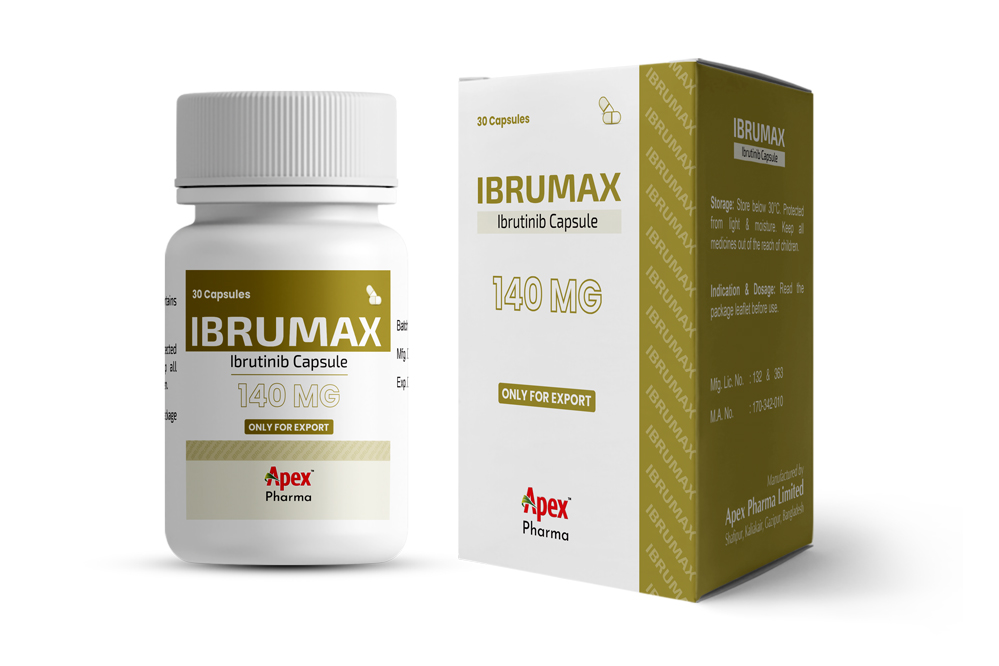
Ibrumax (Export)
Home / By Brand Name / Ibrumax (Export)
Composition
Each Ibrumax
capsule contains ibrutinib 140 mg.
Clinical
Pharmacology
Ibrutinib is a
small-molecule inhibitor of Bruton’s tyrosine kinase (BTK). It binds covalently
to the BTK active site and inhibits its activity. BTK plays a role in B-cell
signaling, and nonclinical studies show that ibrutinib inhibits malignant
B-cell proliferation and survival.
Indications and
Usage
• Mantle cell
lymphoma (MCL) in patients who have received at least one prior therapy.
• Chronic
lymphocytic leukemia (CLL) or small lymphocytic lymphoma (SLL) in adults,
including CLL/SLL with 17p deletion.
• Waldenström
macroglobulinemia (WM).
• Marginal zone
lymphoma (MZL) in patients who require systemic therapy and have received at
least one prior anti-CD20-based therapy.
• Chronic
graft-versus-host disease (cGVHD) in adults after failure of one or more lines
of systemic therapy.
Dosage and
Administration
Take Ibrumax
orally once daily at approximately the same time each day. Swallow the capsules
whole with water. Do not open, break, or chew them.
• MCL and MZL:
560 mg (four 140 mg capsules) once daily until disease progression or
unacceptable toxicity.
• CLL/SLL and
WM: 420 mg (three 140 mg capsules) once daily until disease progression or
unacceptable toxicity.
• cGVHD in
adults: 420 mg (three 140 mg capsules) once daily until cGVHD progression,
recurrence of the underlying malignancy, or unacceptable toxicity.
Refer to the
full prescribing information for combination regimens, dose modifications for
adverse reactions or drug interactions, and dosing in patients with hepatic
impairment.
Missed Dose
Take the missed
dose as soon as possible on the same day. Resume the usual schedule the next
day. Do not take extra capsules to make up for a missed dose.
Contraindications
Hypersensitivity
to ibrutinib or any of the excipients.
Warnings and
Precautions
Serious risks
include hemorrhage, infections, cytopenias, cardiac arrhythmias, hypertension,
second primary malignancies, tumor lysis syndrome, and embryo-fetal toxicity.
Monitor complete blood counts monthly and monitor patients for bleeding,
infection, cardiac symptoms, and elevated blood pressure. Concomitant
antiplatelet or anticoagulant therapy may increase bleeding risk.
Adverse
Reactions
Common adverse
reactions include thrombocytopenia, diarrhea, neutropenia, anemia, fatigue,
musculoskeletal pain, peripheral edema, upper respiratory tract infection,
nausea, bruising, shortness of breath, constipation, rash, abdominal pain,
vomiting, and decreased appetite.
Drug
Interactions
CYP3A
inhibitors may increase ibrutinib exposure, while strong CYP3A inducers may
decrease it. Refer to the full prescribing information for coadministration and
dose-adjustment guidance. Avoid grapefruit and Seville oranges during
treatment.
Use in
Pregnancy and Lactation
Ibrutinib may
cause fetal harm. Verify pregnancy status before starting treatment in patients
of reproductive potential. Advise females of reproductive potential to avoid
pregnancy and males to avoid fathering a child during treatment and for one
month after the last dose. The supplied insert reports no information on the
presence of ibrutinib or its metabolites in human milk or their effects on a
breastfed infant or milk production.
Packaging
Each child-resistant HDPE container contains 30 capsules and one silica gel packet.
Storage ConditionsStore below 30°C. Protect from light and moisture. Keep out of the reach of children.
PRODUCTS
Apex Pharma Has
60+ Pharmaceuticals Brands
of Different Generics