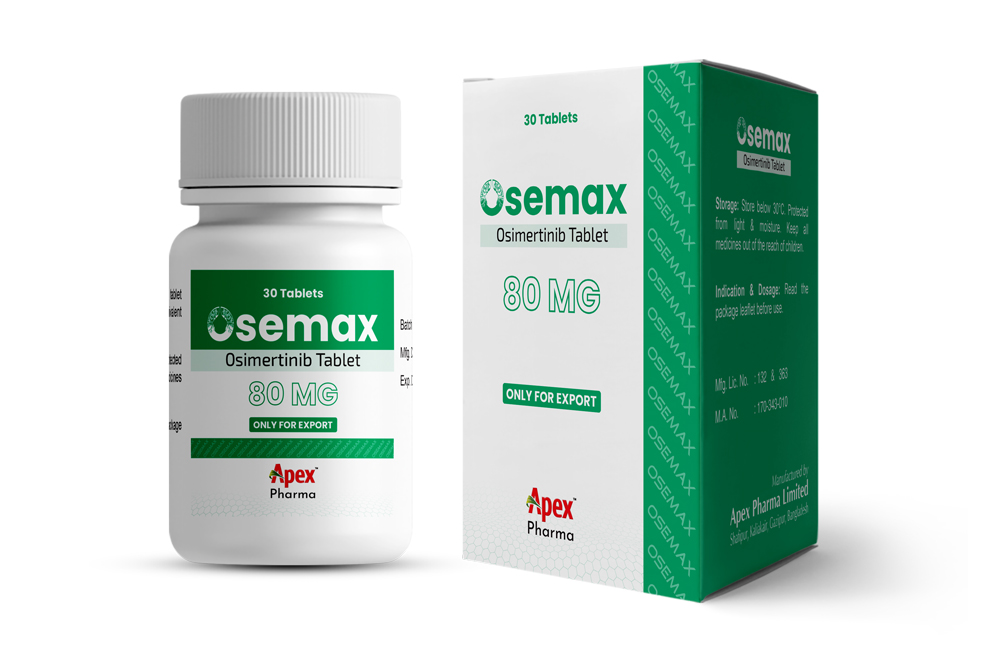
Osemax (Export)
Home / By Brand Name / Osemax (Export)
COMPOSITION
Osemax Tablet:
Each film-coated tablet contains Osimertinib Mesylate equivalent to Osimertinib
80 mg.
PHARMACOLOGY
Mechanism of
Action
Osimertinib is
a kinase inhibitor of the epidermal growth factor receptor (EGFR), which binds
irreversibly to certain mutant forms of EGFR (T790M, L858R, and exon 19
deletion) at approximately 9-fold lower concentrations than wild-type. In
cultured cells and animal tumor implantation models, Osimertinib exhibited
anti-tumor activity against NSCLC lines harboring EGFR mutations (T790M/L858R,
L858R, T790M/exon 19 deletion, and exon 19 deletion) and, to a lesser extent,
wild-type EGFR amplifications. Two pharmacologically active metabolites (AZ7550
and AZ5104 circulating at approximately 10% of the parent) with similar
inhibitory profiles to Osimertinib have been identified in the plasma after
oral administration of Osimertinib. AZ7550 showed a similar potency to
Osimertinib, while AZ5104 showed greater potency against exon 19 deletion and
T790M mutants (approximately 8-fold) and wild-type (approximately 15-fold)
EGFR. In vitro, Osimertinib also inhibited the activity of HER2, HER3, HER4,
ACK1, and BLK at clinically relevant concentrations.
Pharmacokinetics
The area under
the plasma concentration-time curve (AUC) and maximal plasma concentration
(Cmax) of Osimertinib increased dose proportionally over the 20 to 240 mg dose
range (i.e., 0.25 to 3 times the recommended dosage) after oral administration
and exhibited linear pharmacokinetics (PK). Administration of Osimertinib
orally once daily resulted in approximately 3-fold accumulation, with
steady-state exposures achieved after 15 days of dosing. At steady state, the
Cmax to Cmin (minimal concentration) ratio was 1.6-fold.
Absorption
The median time
to Cmax of Osimertinib was 6 hours (range 3–24 hours). Following administration
of a 20 mg Osimertinib tablet with a high-fat, high-calorie meal (containing
approximately 58 grams of fat and 1000 calories), the Cmax and AUC of
Osimertinib increased by 14% and 19%, respectively, compared to fasting
conditions.
Distribution
The mean volume
of distribution at steady state (V/F) of Osimertinib was 986 L. Plasma protein
binding of Osimertinib is likely high based on its physiochemical properties.
Elimination
Osimertinib
plasma concentrations decreased with time, and a population-estimated mean
half-life of Osimertinib was 48 hours. Oral clearance (CL/F) was 14.2 L/h.
Metabolism
The main
metabolic pathways of Osimertinib were oxidation (predominantly CYP3A) and
dealkylation in vitro. Two pharmacologically active metabolites (AZ7550 and
AZ5104) have been identified in the plasma after Osimertinib oral
administration. The geometric mean exposure (AUC) of each metabolite (AZ5104
and AZ7550) was approximately 10% of the exposure of Osimertinib at steady
state.
Excretion
Osimertinib is
primarily eliminated in the feces (68%) and to a lesser extent in the urine
(14%). Unchanged Osimertinib accounted for approximately 2% of the elimination.
Specific
Populations
No clinically
significant differences in the pharmacokinetics of Osimertinib were observed
based on age, sex, ethnicity, body weight, smoking status, mild (CLcr 60–89
mL/min) or moderate (CLcr 30–59 mL/min) renal impairment, or mild hepatic
impairment (total bilirubin
INDICATIONS AND
USAGE
Osimertinib is
a kinase inhibitor indicated for the treatment of patients with metastatic
epidermal growth factor receptor (EGFR) T790M mutation-positive non-small cell
lung cancer (NSCLC), as detected by an FDA-approved test, who have progressed
on or after EGFR TKI therapy.
DOSAGE AND
ADMINISTRATION
Recommended
Dosage Regimen
The recommended
dose of Osimertinib is one 80 mg tablet once a day until disease progression or
unacceptable toxicity. Osimertinib can be taken with or without food. If a dose
of Osimertinib is missed, do not make up the missed dose and take the next dose
as scheduled. Administration to Patients Who Have Difficulty in Swallowing
Solids Disperse the tablet in 4 tablespoons (approximately 50 mL) of
non-carbonated water only. Stir until the tablet is completely dispersed and
swallow or administer through a nasogastric tube immediately. Do not crush,
heat, or ultrasonicate during preparation. Rinse the container with 4 to 8
ounces of water and immediately drink or administer through a nasogastric tube.
Recommended
Dose Modifications for Osimertinib
Pulmonary
- Interstitial
lung disease (ILD)/pneumonitis: Permanently discontinue Osimertinib.
Cardiac
- QTc interval
greater than 500 msec on at least 2 separate ECGs: Withhold Osimertinib until
the QTc interval is less than 481 msec or has recovered to baseline. If
baseline QTc is greater than or equal to 481 msec, resume at the 40 mg dose.
- QTc interval
prolongation with signs or symptoms of life-threatening arrhythmia: Permanently
discontinue Osimertinib.
- Asymptomatic
absolute decrease in LVEF of 10% from baseline and below 50%: Withhold
Osimertinib for up to 4 weeks. If LVEF improves to baseline, resume. If LVEF
does not improve to baseline, permanently discontinue.
- Symptomatic
congestive heart failure: Permanently discontinue Osimertinib.
Other
- Adverse
reaction of Grade 3 or greater severity: Withhold Osimertinib for up to 3
weeks.
- If the
reaction improves to Grade 0–2 within 3 weeks: Resume at 80 mg or 40 mg daily.
- If there is
no improvement within 3 weeks: Permanently discontinue Osimertinib.
ECGs =
electrocardiograms
LVEF = left
ventricular ejection fraction
QTc = QT
interval corrected for heart rate
CONTRAINDICATIONS
Hypersensitivity
to Osimertinib or to any of the additives.
WARNINGS AND
PRECAUTIONS
Interstitial
Lung Disease (ILD)/Pneumonitis
Interstitial
lung disease (ILD)/pneumonitis occurred in 3.3% of patients. Permanently
discontinue Osimertinib in patients diagnosed with ILD/pneumonitis.
QTc Interval
Prolongation
Monitor
electrocardiograms and electrolytes in patients who have a history or
predisposition for QTc prolongation, or those who are taking medications that
are known to prolong the QTc interval. Withhold, then restart at a reduced dose
or permanently discontinue Osimertinib.
Cardiomyopathy
Cardiomyopathy
occurred in 1.4% of patients. Assess left ventricular ejection fraction (LVEF)
before treatment and then every 3 months thereafter.
Keratitis
Advise patients
to contact their healthcare provider immediately if they develop eye symptoms
(eye inflammation, lacrimation, light sensitivity, eye pain, red eye, or
changes in vision).
Embryo-Fetal
Toxicity
Osimertinib can
cause fetal harm. Advise females of potential risk to the fetus and to use
effective contraception during treatment with Osimertinib (Osemax) and for 6
weeks after the final dose. Advise males to use effective contraception for 4
months after the last dose of Osimertinib.
ADVERSE
REACTIONS
Most common
adverse reactions (≥25%) were diarrhea, rash, dry skin, and nail toxicity.
DRUG
INTERACTIONS
Effect of Other
Drugs on Osimertinib
Strong CYP3A
Inhibitors
Avoid
concomitant administration of Osimertinib (Osemax) with strong CYP3A
inhibitors, including macrolide antibiotics (e.g., Telithromycin), antifungals
(e.g., Itraconazole), antivirals (e.g., Ritonavir), and Nefazodone, as
concomitant use of strong CYP3A inhibitors may increase Osimertinib (Osemax)
plasma concentrations. If no other alternative exists, monitor patients more
closely for adverse reactions of Osimertinib.
Strong CYP3A
Inducers
Avoid
concomitant administration of Osimertinib (Osemax) with strong CYP3A inducers
(e.g., Phenytoin, Rifampicin, Carbamazepine, St. John's Wort), as strong CYP3A
inducers may decrease Osimertinib (Osemax) plasma concentrations.
Effect of
Osimertinib on Other Drugs
Avoid
concomitant administration of Osimertinib (Osemax) with drugs that are
sensitive substrates of CYP3A, breast cancer resistance protein (BCRP), or
CYP1A2 with narrow therapeutic indices, including but not limited to Fentanyl,
Cyclosporine, Quinidine, Ergot Alkaloids, Phenytoin, and Carbamazepine, as
Osimertinib (Osemax) may increase or decrease plasma concentrations of these
drugs.
USE IN SPECIFIC
POPULATIONS
Pregnancy
Osimertinib
(Osemax) can cause fetal harm when administered to a pregnant woman. There is
no available data on Osimertinib (Osemax) use in pregnant women.
Lactation
There is no
data on the presence of Osimertinib (Osemax) in human milk, the effects of
Osimertinib (Osemax) on the breastfed infant, or on milk production. Because of
the potential for serious adverse reactions in breastfed infants from
Osimertinib, advise a lactating woman not to breastfeed during treatment with
Osimertinib (Osemax) and for 2 weeks after the final dose.
Females and
Males of Reproductive Potential
Contraception
Females: Advise
females of reproductive potential to use effective contraception during
treatment with Osimertinib (Osemax) and for 6 weeks after the final dose.
Males: Advise
male patients with female partners of reproductive potential to use effective
contraception during and for 4 months following the final dose of Osimertinib.
Infertility
Based on animal
studies, Osimertinib (Osemax) may impair fertility in females and males of
reproductive potential. It is not known if the effects on fertility are
reversible.
Pediatric Use
The safety and
effectiveness of Osimertinib (Osemax) in pediatric patients have not been
established.
Geriatric Use
No overall
differences in effectiveness were observed based on age. Exploratory analysis
suggests a higher incidence of Grade 3 and 4 adverse reactions (32% versus 25%)
and more frequent dose modifications for adverse reactions (23% versus 17%) in
patients 65 years or older as compared to those younger than 65 years.
Renal
Impairment
No dedicated
clinical studies have been conducted to evaluate the effect of renal impairment
on the pharmacokinetics of Osimertinib. Based on population pharmacokinetic
analysis, no dose adjustment is recommended in patients with mild [creatinine
clearance (CLcr) 60–89 mL/min] or moderate (CLcr 30–59 mL/min) renal
impairment. There is no recommended dose of Osimertinib (Osemax) for patients
with severe renal impairment (CLcr <30 mL/min) or end-stage renal disease.
Hepatic
Impairment
No dedicated
clinical studies have been conducted to evaluate the effect of hepatic
impairment on the pharmacokinetics of Osimertinib. Based on population
pharmacokinetic (PK) analysis, no dose adjustment is recommended in patients
with mild hepatic impairment [total bilirubin
DRUG
INTERACTIONS
Clinical
studies evaluating Osimertinib in the presence of strong CYP3A inhibitors have
not been conducted. Clinical studies evaluating Osimertinib in the presence of
strong CYP3A inducers have not been conducted. The exposure of Osimertinib was
not affected by concurrent administration of a single 80 mg Osimertinib tablet
following 40 mg omeprazole administration for 5 days. Osimertinib is a
competitive inhibitor of CYP3A, but not CYP2C8, 1A2, 2A6, 2B6, 2C9, 2019, 2D6
and 2E1 in vitro. Osimertinib induced CYP3A4 (Pregnane X dependent) and CYP1A2
enzymes. Based on in vitro studies, osimertinib is a substrate of
P-glycoprotein and BCRP and is not a substrate of OATP1B1 and OATP1B3.
Osimertinib is an inhibitor of BCRP and does not inhibit P-glycoprotein, OAT1,
OAT3, OATP1B1, OATP1B3, MATE1, MATE2K and OCT2 in vitro.
NONCLINICAL
TOXICOLOGY
Carcinogenesis,
Mutagenesis, Impairment of Fertility
Carcinogenicity
studies have not been performed with Osimertinib. Osimertinib did not cause
genetic damage in in vitro and in vivo assays. Based on studies in animals,
male fertility may be impaired by treatment with Osimertinib. Degenerative
changes were present in the testes in rats and dogs exposed to Osimertinib for
1 month or more with evidence of reversibility in the rat. Following
administration of Osimertinib to rats for approximately 10 weeks at a dose of
40 mg/kg, at exposures 0.5 times the AUC observed in patients at the
recommended dose of 80 mg, there was a reduction in male fertility,
demonstrated by increased pre-implantation loss in untreated females mated to
treated males. No dedicated female fertility studies have been conducted. In
repeat dose toxicity studies, histological evidence of anestrus, corpora lutea
degeneration in the ovaries, and epithelial thinning in the uterus and vagina
were seen in rats exposed to Osimertinib for 1 month or more at exposures 0.3
times the AUC observed in patients at the recommended dose of 80 mg. Findings
in the ovaries seen following 1 month of dosing exhibited evidence of
reversibility.
PACKAGING
Osemax Tablet: Each child-resistant HDPE container contains 30 tablets and one packet of silica gel.
Storage ConditionsStore below 30°C. Protect from light and moisture. Keep all medicines out of the reach of children.
PRODUCTS
Apex Pharma Has
60+ Pharmaceuticals Brands
of Different Generics